Calibration
Radiocarbon measurements are always reported in terms of years 'before present' - BP. 'Present' always refer to 1950 so you do not have to know the year in which the measurement was made. The resulting figure is directly based on the proportion of radiocarbon found in the sample. It is calculated on the assumption that the concentration of atmospheric radiocarbon has always been the same as it was in 1950 and that the half-life of radiocarbon is 5568 years.
However, things are not that straightforward for two reasons. Firstly the proportion of radiocarbon in the atmosphere has varied by a few percent over time, and secondly the true half life of radiocarbon is 5730 years, not 5568 as originally thought.
In order to see what a radiocarbon determination means in terms of a true age we need to know how the atmospheric concentration has changed with time.
Calibrating Measurements
The information from measurements on tree rings and other samples of known age (including speleothems, marine corals and samples from sedimentary records with independent dating) are all compiled into calibration curves by the IntCal group. These are the basis for the calibrations performed by the programs like CALIB and OxCal.
Calibration of radiocarbon determinations is in principle very simple. If you have a radiocarbon measurement on a sample, you can try to find a tree ring with the same proportion of radiocarbon. Since the calendar age of the tree rings is known, this then tells you the age of your sample.
In practice this is complicated by two factors:
-
the measurements on both the tree rings and the samples have a limited precision and so there will be a range of possible calendar years
-
given the way the atmospheric radiocarbon concentration has varied, there might be several possible ranges
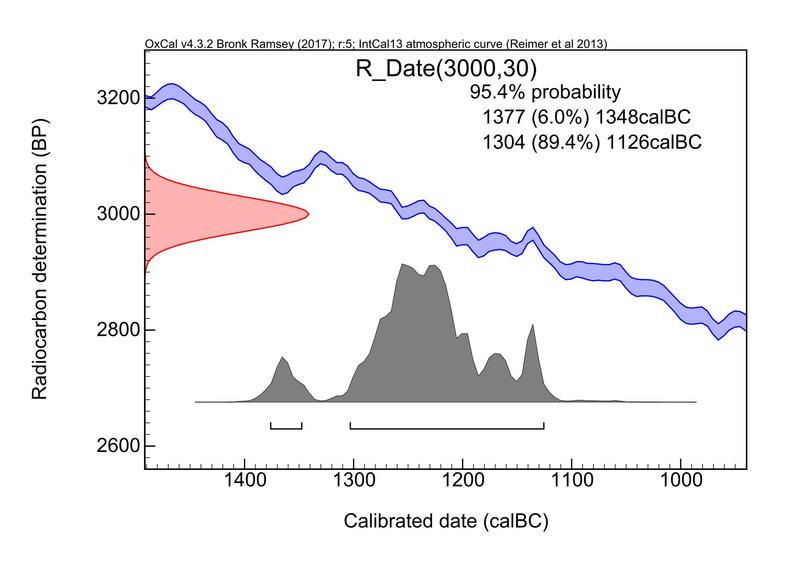
The example below shows how OxCal calibrates radiocarbon data. This plot shows how the radiocarbon measurement 3000+-30BP would be calibrated. The left-hand axis shows radiocarbon concentration expressed in years `before present' and the bottom axis shows calendar years (derived from the tree ring data). The pair of blue curves show the radiocarbon measurements on the tree rings (plus and minus one standard deviation) and the red curve on the left indicates the radiocarbon concentration in the sample. The grey histogram shows possible ages for the sample (the higher the histogram the more likely that age is).
The results of calibration are often given as an age range. In this case, we might say that we could be 95% sure that the sample comes from between 1377 cal BC and 1126 cal BC.
Reporting Radiocarbon Dates
Radiocarbon dates should always be reported either as `percent modern' or years `before present' (BP). The first indicates the proportion of radiocarbon atoms in the sample as compared to samples modern in 1950. The second is directly derived from this on the assumption that the half-life of radiocarbon is 5568 years and the amount of radiocarbon in the atmosphere has been constant.
Once calibrated a radiocarbon date should be expressed in terms of cal BC, cal AD or cal BP. The cal prefix indicates that the dates are the result of radiocarbon calibration using tree ring data. These values should correspond exactly to normal historical years BC and AD. The term cal BP means the number of years before 1950 and can be directly compared to calendar years.
Methods of Calculating Ranges
There are two main methods used for calculating age ranges from the calibration curve:
The first method to be employed was called the `intercept method' because it can be done by drawing intercepts on a graph. This method will tell you the years in which the radiocarbon concentration of tree rings is within two standard deviations of your measurement (e.g. between 2940BP and 3060BP for the measurement 3000+-30BP).
A slightly different method is now more often used which is called the `probability method'. This requires a computer since the calculations are more complicated. It gives the time range, from which you can be 95% sure the sample came.